AI Search Optimization: How to Get Your Pages Found and Cited in AI Answers
AI search optimization is the work of getting your pages fetched, understood and cited when ChatGPT, Perplexity, Copilot or Google's AI features answer a question. Most of it is SEO you already know, done more strictly. A few parts are new: which crawler each assistant uses, how much of your page sits in plain HTML, and how you measure answers that never send a click.
What Is AI Search Optimization?
AI search optimization means making your content easy for AI search systems to retrieve and safe for them to cite. You will see it called GEO (generative engine optimization), AEO (answer engine optimization) or LLMO. The names differ; the work overlaps. Google's own guide to optimizing for generative AI features, published May 15, 2026, treats AEO and GEO as part of SEO, because its AI features run on its core ranking and quality systems.
That is true for Google. Other assistants run their own crawlers and their own ranking, so the access side differs by engine. SEO vs AEO vs GEO on SEO ProCheck lays out where the three terms really differ.
How AI Search Picks Its Sources
Every AI search product follows the same three steps. It turns the question into one or more searches, retrieves pages from an index, then writes an answer and cites some of those pages. Google calls the first step query fan-out: one question becomes several related searches across subtopics.
| Product | Crawler to allow | Index | Docs |
|---|---|---|---|
| Google AI Overviews, AI Mode | Googlebot | Google Search | |
| ChatGPT search | OAI-SearchBot | OpenAI + partners | OpenAI |
| Perplexity | PerplexityBot | Perplexity | Perplexity |
| Copilot, Bing AI | Bingbot | Bing | Bing |
| Claude search | Claude-SearchBot | Anthropic | Anthropic |
So the first rule is simple: if the crawler behind an assistant cannot fetch the page, that assistant cannot cite it from its index. Blocking GPTBot (training) does not remove you from ChatGPT search; blocking OAI-SearchBot does. The AI crawlers guide lists every token.
What Helps, and What Does Not
Google's guide lists both sides. The other assistants publish less, but nothing they publish contradicts it.
| Tactic | Helps | Source |
|---|---|---|
| Crawlable, indexable pages | ✓ | Google, OpenAI |
| Main content as HTML text | ✓ | |
| First-hand, non-commodity content | ✓ | |
| Clear headings and paragraphs | ✓ | |
| Structured data matching the page | ◐ | |
| llms.txt | – | Google Search |
| Chunking into tiny pages | – | |
| Rewriting just for AI | – | |
| Manufactured brand mentions | – |
Structured data is marked partly: Google says no special schema is needed for its AI features and that it remains useful for rich results. On llms.txt, Google says Google Search ignores it; see the llms.txt guide for what other assistants say. Mass-producing pages for query variations falls under Google's scaled content abuse policy.
Make Every Page Retrievable
Access problems are the most common reason a good page is never cited, and the easiest to fix.
| Check | Pass | Fail |
|---|---|---|
| robots.txt for the AI search crawler | Allowed | Disallowed |
| Server or CDN answer | 200 | 401, 403, 429 |
| Main content | In the raw HTML | Only after JavaScript |
| Snippet controls | None on key pages | nosnippet, max-snippet:0 |
| Indexing | Indexable | noindex, canonical elsewhere |
| Status of cited URLs | 200 | 404, 410 |
The firewall row catches many sites. robots.txt can allow a crawler while a CDN bot rule answers it with 403. Test what each crawler actually receives, not what robots.txt says it may fetch.
We found on our own site, neova.app, on November 20, 2026, that the favicon files sat behind Disallow: /, so Google showed a plain letter instead of the logo next to the site in results until /favicon and /apple-touch-icon.png were allowed. One broad rule, a visible cost in search. AI crawlers read the same file.
Write Pages AI Answers Can Use
- Answer first. Put the direct answer in the first sentence or two under each question heading, then the detail.
- Use real numbers. Sizes, prices, limits, dates. A claim with a figure is easier to quote than an adjective.
- Keep key facts in text. Not only in an image, a PDF, a chart or a widget.
- State relationships. Write "X works with Y" or "the limit is 20" instead of leaving the reader to infer it.
- Retire old versions. If a 2025 page and a 2026 page compete, redirect or clearly link the old one.
- Get the main content early. Long menus and boilerplate before the main text push it far down the HTML.
| Page element | Target |
|---|---|
| Main content starts | Within 5,000 characters |
| Long page summary | At the top, matches body |
| Question heading | Answered in 1 to 2 sentences |
| Definition page | Defines in sentence 1 |
| Steps | Ordered list |
On our own seoprocheck.com crawl of October 17, 2026, Neova found 56 duplicate titles and 557 titles over 60 characters across 4,561 HTML pages. Titles and headings are part of what retrieval matches on, so these are worth fixing for AI search too.
Measure AI Search Results
Rankings do not tell you whether you are cited. Use these instead:
| Measure | Source | Since |
|---|---|---|
| AI impressions in Google | Search Console | June 3, 2026 |
| Citations in Copilot, Bing AI | Bing Webmaster Tools | February 10, 2026 |
| Pages cited in AI answers | Microsoft Clarity | Last 28 days |
| ChatGPT, Perplexity mentions | Prompt sampling | Your schedule |
| AI-referred sessions | Google Analytics 4 | Ongoing |
The AI visibility checker guide covers each source and how to read it. For Google's AI features specifically, see AI Overviews SEO; for ChatGPT, ChatGPT SEO.
AI Search Optimization With Neova
Neova's AI Search category covers access, content and citations in one crawl, in the desktop app on Mac, Windows and Linux and in Neova Online.
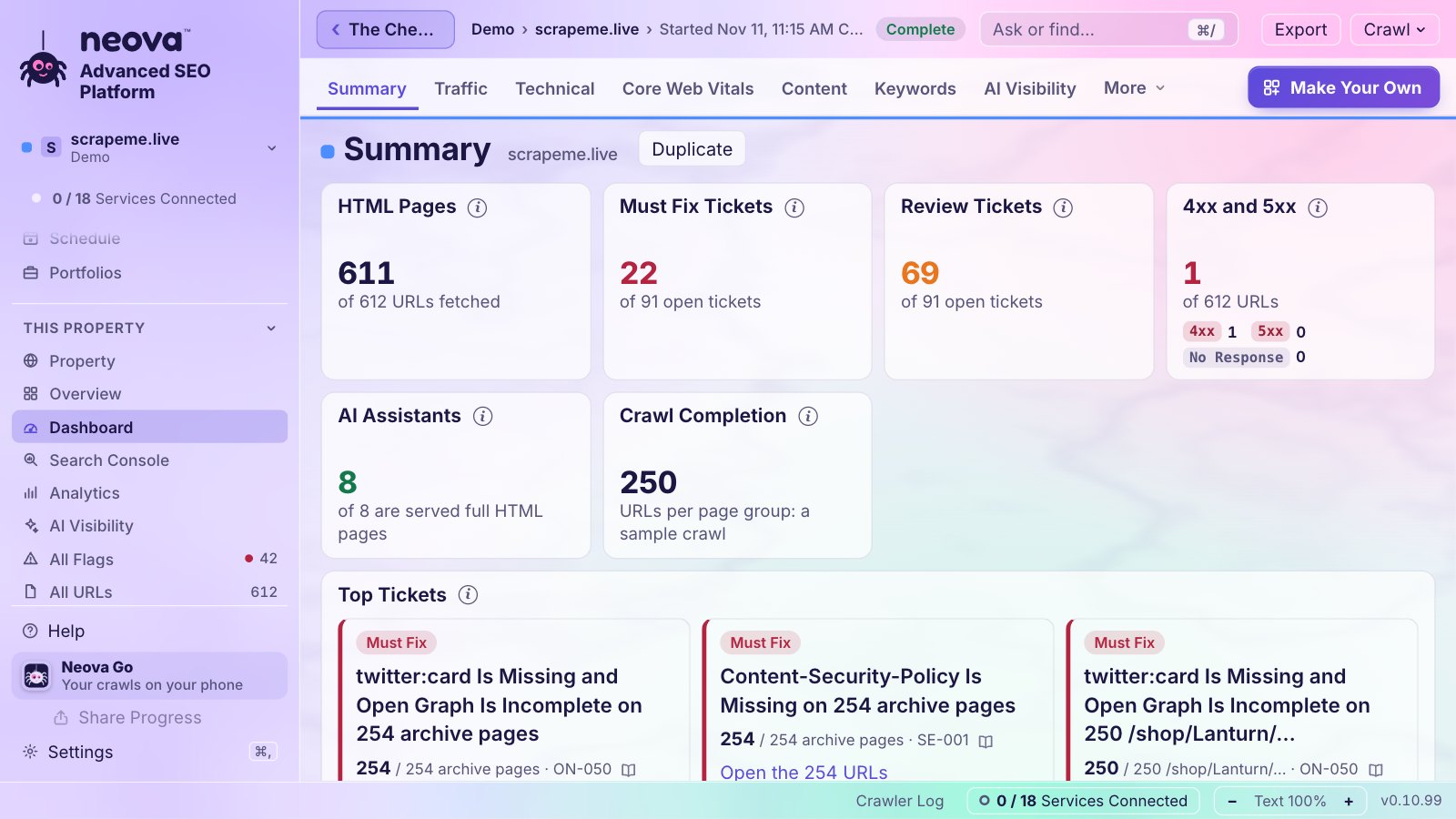
Checks to start with:
- Key HTML Page Restricts Snippets or Blocks AI Search Crawlers
- Request With an AI Search Crawler User Agent Is Blocked
- Main Content Starts After the First 5,000 Characters of Body Text
- Long HTML Page Does Not Open With a Matching Summary
- Question Heading Is Not Addressed Directly in the Text Below It
- Key Fact Is Only in an Image, PDF, Video, Canvas or Widget
- Claims of Size, Cost, Speed or Results Have No Figures Behind Them
- Older Version of the Content Competes With the Current URL
The content judgments come from AI Review, which runs a local model through Ollama in the desktop app; nothing leaves your computer, and its flags stay out of the counts. What Each AI Assistant Is Served asks sampled pages as 10 AI agents and shows who gets the full page. The Free plan crawls 1,000 URLs with every check; download Neova or see Features.
Questions
What is AI search optimization?
Making your pages easy for AI search systems such as ChatGPT search, Perplexity, Copilot and Google's AI Overviews to fetch, understand and cite. It is also called GEO, AEO or LLMO.
Is AI search optimization different from SEO?
Mostly not. Google says its AI features rely on its core ranking systems, so SEO applies. The new parts are the separate crawlers other assistants use and measuring citations instead of rankings.
Do I need special markup for AI search?
No. Google says no special schema.org markup, AI text files or Markdown is needed for its AI features. Structured data that matches the page still helps with rich results.
Which crawlers should I allow for AI search?
Googlebot for Google's AI features, Bingbot for Copilot, OAI-SearchBot for ChatGPT search, PerplexityBot for Perplexity and Claude-SearchBot for Claude. Training crawlers such as GPTBot are a separate choice.
How do I know if AI search cites my site?
Use Bing Webmaster Tools' AI Performance report, Search Console's generative AI reports, Microsoft Clarity's AI Visibility, and a fixed list of prompts asked to ChatGPT and Perplexity on a schedule.